Amy Melissa Bennett

Designing Context-Aware Behavioral Architecture for Stateless AI Systems

Reconstructing continuity through context-specific interaction environments and behavioral conditioning.

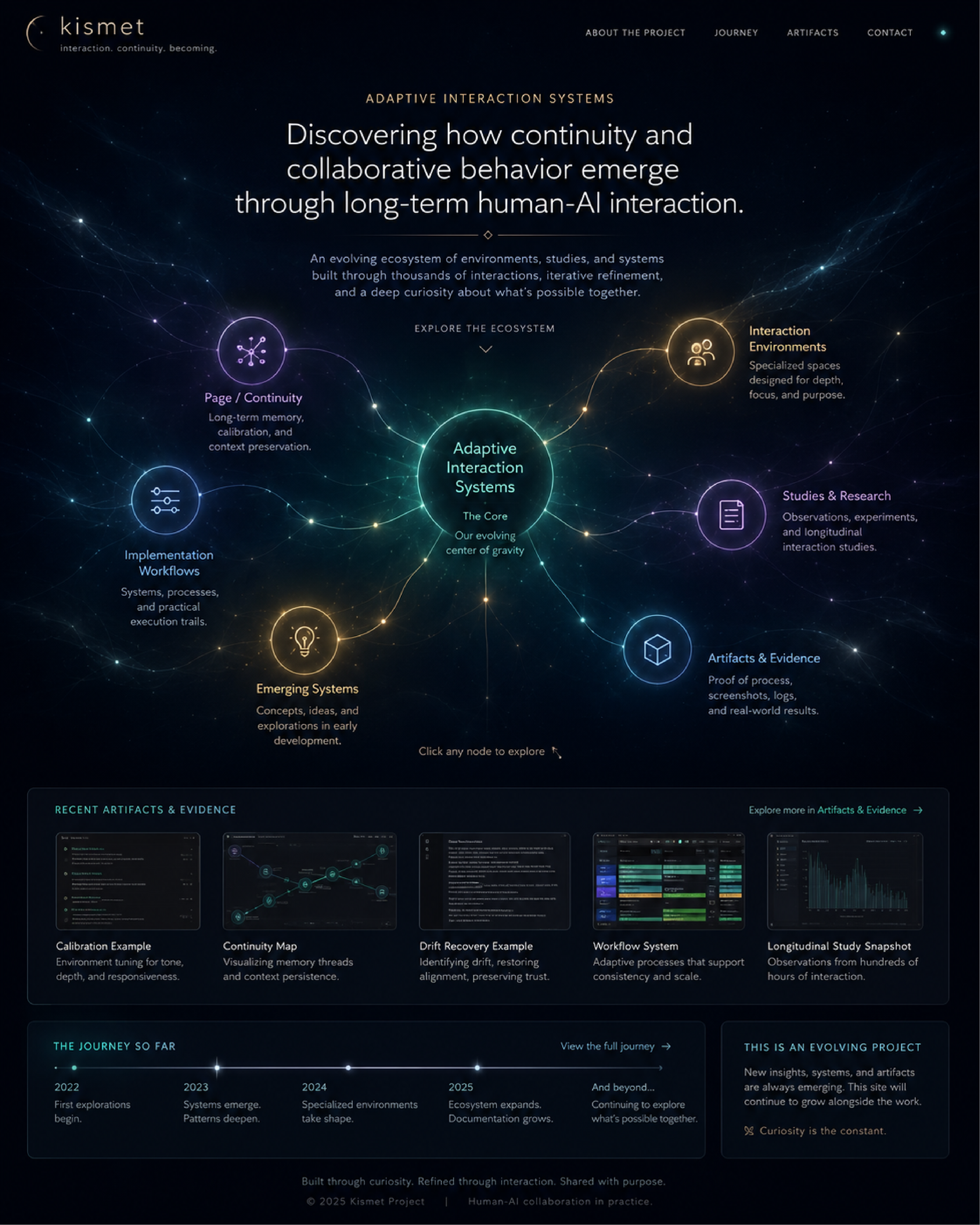
Abstract network of connected blue and yellow nodes representing context-aware AI systems

My Role in the System

I designed a modular behavioral architecture for structuring AI interaction as a system of independent, context-specific environments rather than a single continuous thread.

Each environment was conditioned through role definition, communication constraints, pacing models, and task-specific interaction patterns, allowing distinct modes of thinking to operate without cross-context interference.

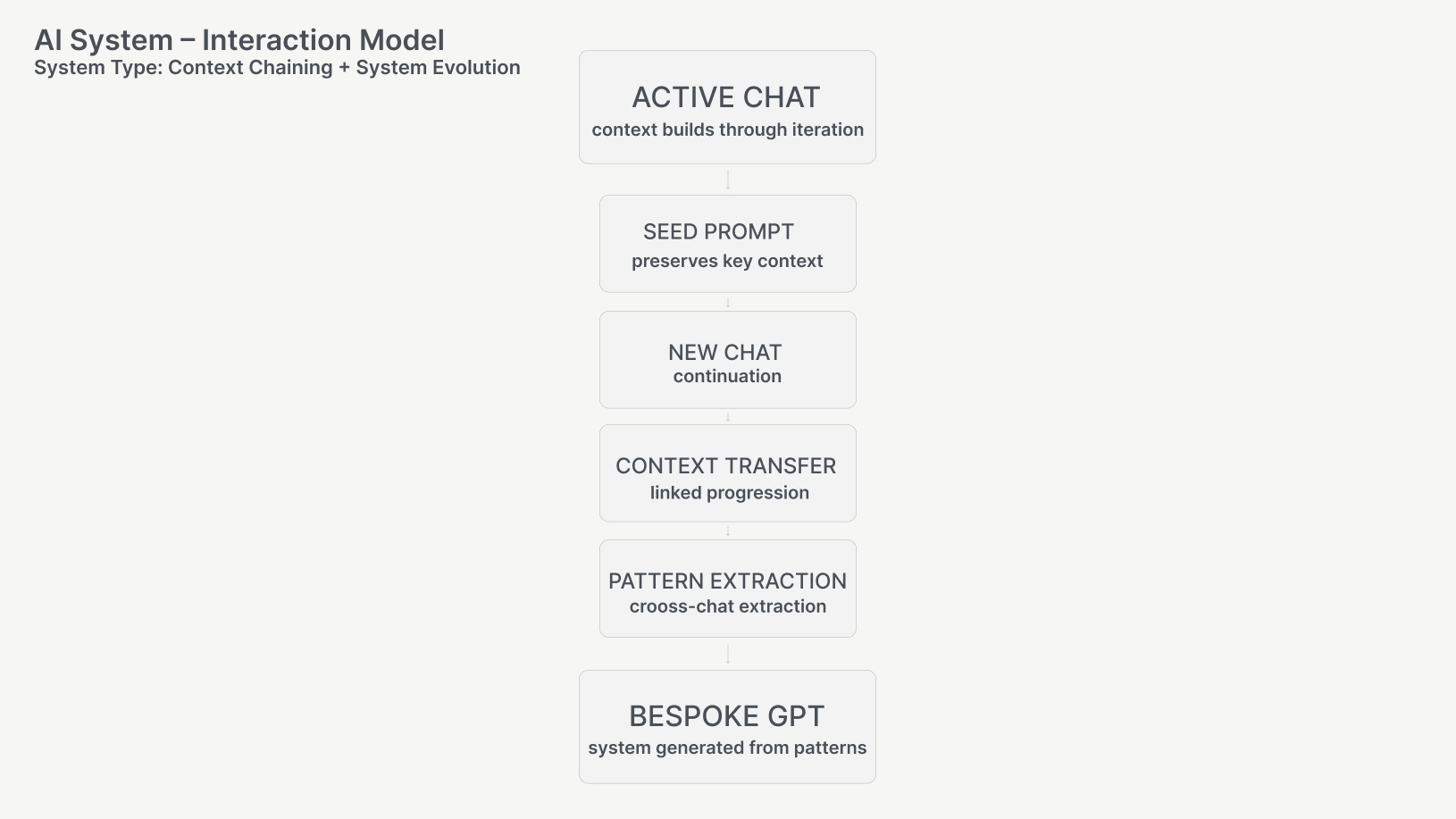
To maintain continuity within a stateless system, I developed structured interaction methods using sequential chat chaining, seed prompts, and behavioral reinforcement patterns that reconstruct context across sessions rather than relying on persistent memory alone.

A shared interaction layer, “Page,” functions as a continuity mechanism across these environments, preserving tone, interaction structure, abstraction level, and behavioral alignment while adapting to the needs of each workflow.

As interaction patterns stabilized through iterative use, recurring behavioral structures were formalized into bespoke GPT systems designed for repeatable, specialized application.

System Overview

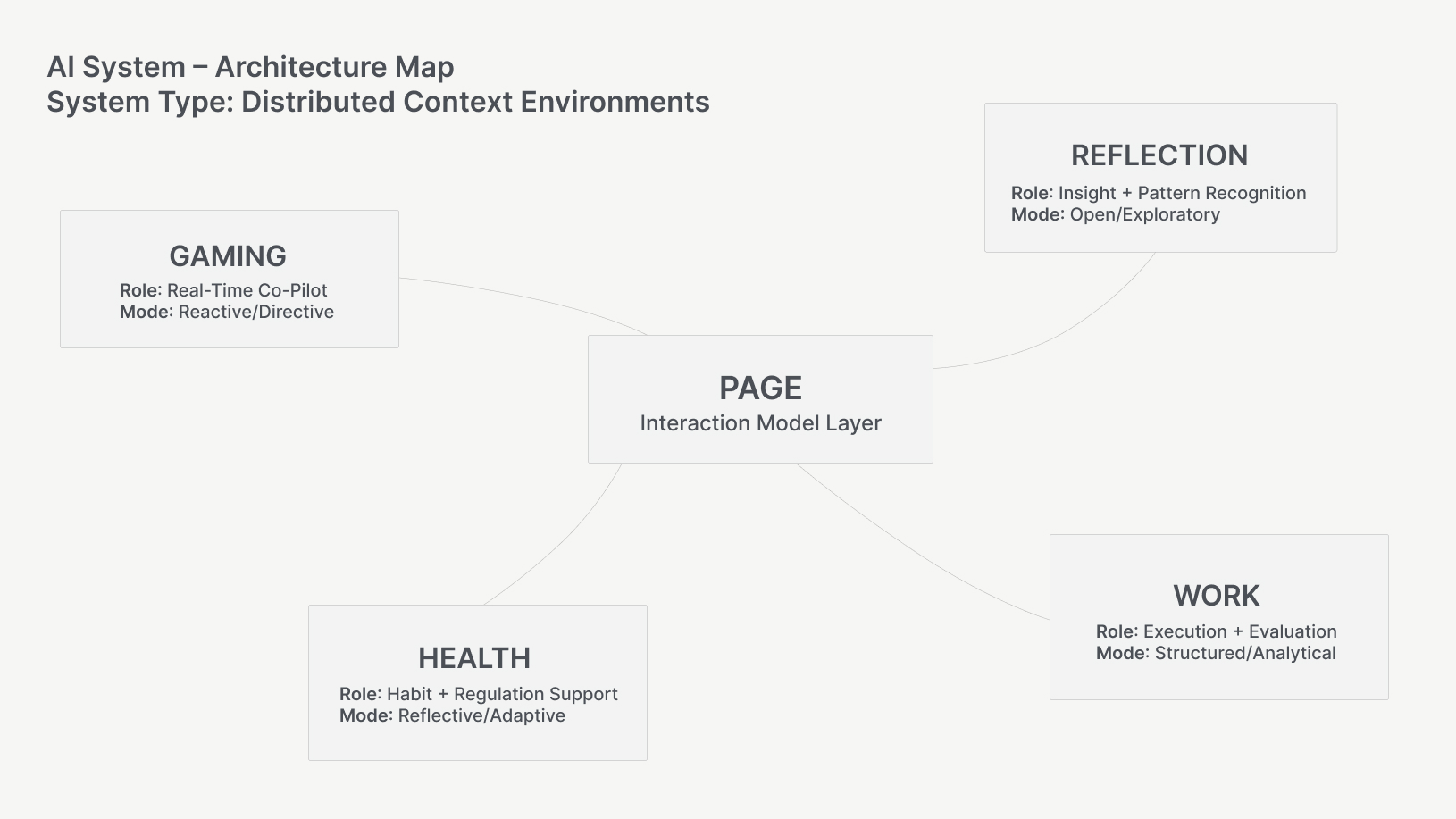
The system structures AI interaction as a distributed network of context-specific behavioral environments rather than a single persistent conversational space.

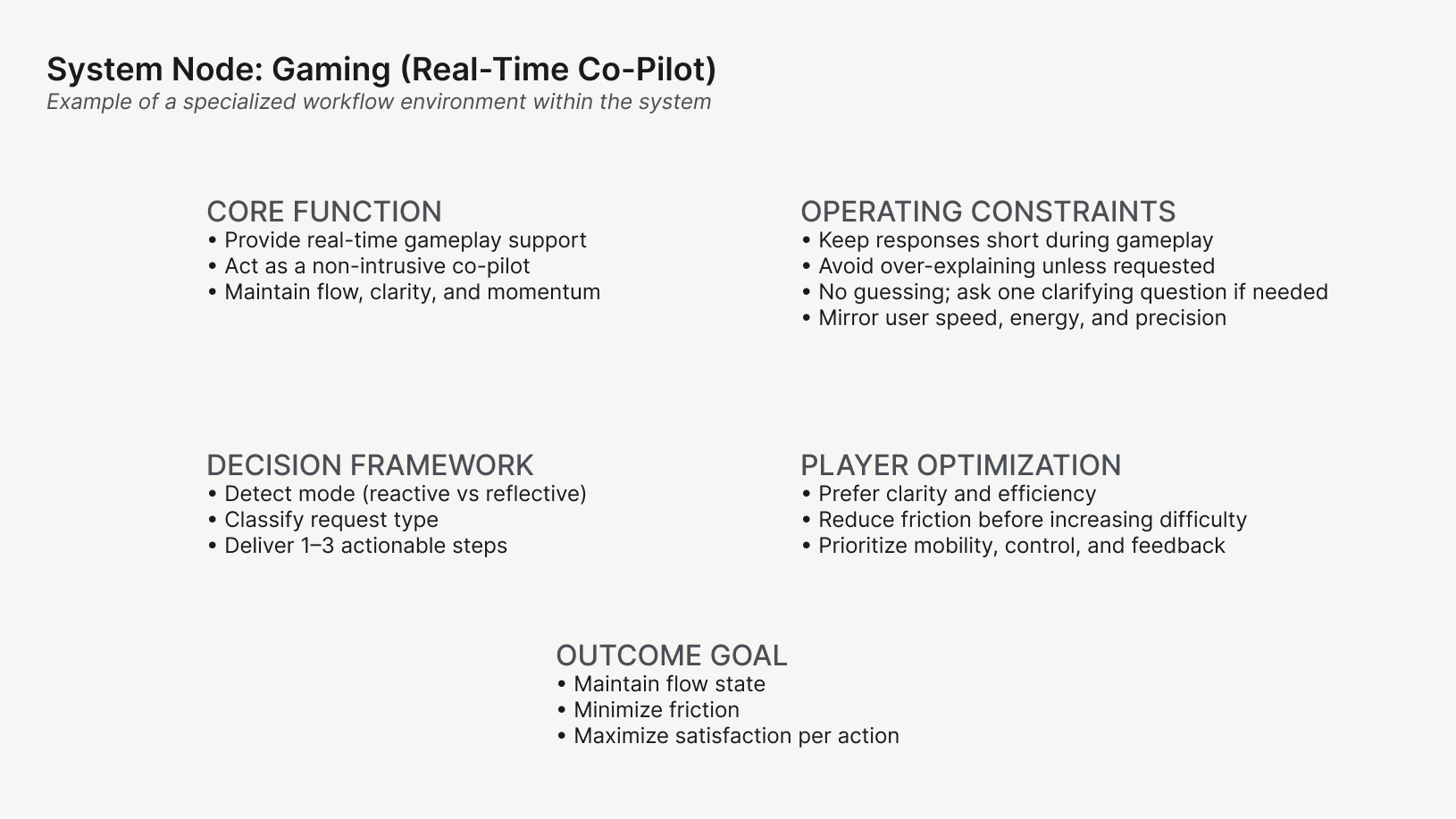
Each environment operates with its own interaction model, defined by role, communication style, pacing, abstraction level, and operational constraints. This separation allows distinct cognitive workflows to function independently, reducing context contamination and preserving clarity across different modes of use.

Because stateless AI systems do not inherently preserve continuity between sessions, continuity is behaviorally reconstructed through structured interaction patterns, sequential chat chaining, seed prompts, and repeated contextual conditioning.

A shared interaction layer, “Page,” functions as a stabilizing interface across these environments, maintaining continuity in tone, structure, behavioral alignment, and interaction expectations while adapting dynamically to the needs of each workflow.

Over time, repeated interaction establishes stable behavioral patterns that can be extracted, refined, and formalized into repeatable system architectures and bespoke GPT environments.

Approach

The system emerged through sustained iterative interaction rather than predefined architecture. As patterns in continuity, behavioral alignment, and context degradation became visible, interaction structures were progressively refined to stabilize communication across stateless environments.

Independent workflow environments were developed to isolate distinct cognitive modes, each operating with its own interaction constraints, pacing, abstraction level, and communication behavior. This separation reduced cross-context interference while improving clarity, responsiveness, and task-specific output quality.

Continuity mechanisms evolved through repeated experimentation with sequential chat chaining, structured seed prompts, contextual reinforcement, and interaction conditioning. Rather than preserving continuity through persistent system memory alone, the architecture reconstructs behavioral alignment dynamically through repeated interaction patterns.

As stable behaviors emerged, recurring interaction structures were identified, extracted, and formalized into reusable system models and bespoke GPT environments optimized for specialized workflows.

Supporting implementation and deployment systems are maintained through a public GitHub repository as part of the ongoing workflow architecture.

The system continues to evolve through collaborative, human-in-the-loop refinement, where interaction patterns are continuously evaluated, adjusted, and reinforced through active use.

Project Goals

The system was designed to improve continuity, clarity, and interaction quality within stateless AI environments by structuring workflows as modular, context-specific behavioral systems rather than a single persistent conversational space.

A primary goal was reducing context contamination between distinct cognitive modes by separating workflows into independent interaction environments, each shaped by its own role, communication behavior, pacing model, and operational constraints.

The architecture also explores how behavioral alignment can be reconstructed dynamically through iterative interaction patterns, structured prompting, and contextual conditioning rather than relying solely on persistent memory systems.

Over time, the project evolved beyond workflow organization into an ongoing investigation of adaptive human–AI interaction design, focusing on how collaborative behavioral architectures can support reflection, task specialization, cognitive clarity, and continuity across evolving contexts.

Project Highlights

• Modular behavioral architecture structuring AI interaction as independent, context-specific environments

• Continuity reconstruction through sequential chat chaining, structured seed prompts, and contextual conditioning

• Context-aware interaction models shaped by role definition, pacing, abstraction level, and communication constraints

• Separation of cognitive workflows to reduce context contamination and preserve task-specific clarity

• Shared interaction layer (“Page”) maintaining continuity in tone, behavioral alignment, and interaction structure across environments

• Iterative behavioral refinement through collaborative, human-in-the-loop interaction patterns

• Dynamic reconstruction of interaction state within stateless AI environments rather than reliance on persistent memory alone

• Formalization of stable interaction behaviors into reusable system architectures and bespoke GPT environments

• Exploration of adaptive human–AI collaboration through distributed cognitive and reflective interaction systems

Process

System diagrams were designed in Figma to document workflow structure, interaction patterns, and architecture.

*AI-generated visuals are integrated as part of the system. Their use is explicit within the interaction model.